
Savej built this system as the germination of the seed that is the Ancient Future Collective, working with a mirror of his own mind: a language model given his context until working with it felt like an expansion of himself rather than a tool. What you build here is not his brain. It is a mirror of your own, seeded with the philosophy underneath all of it: a healthy relationship with artificial intelligence, one that executes your thinking instead of replacing it. Made with love, so that each of us can work with ourselves this way, and grow it as a collective.
Free setup
Build your fractal brain
You explain yourself to AI, it helps, and then it forgets. Next session you start over. This is how you stop doing that.
From the idea to the thing itself
Many of us carry ideas we never build, seeds of inspiration that never germinate because we are not quite sure how to nourish them. It was rarely the seed. It was the ground it needed: money, a team, months of tending, and a kind of technical know-how most of us were never handed. So the seed waits. Sometimes for years. Sometimes for good.
That ground is what is changing. Work that used to need startup capital and a full staff is work one person can now direct. If you have been carrying an idea you felt you could not bring to fruition, a seed you believed you could not germinate because you did not have the technical capability, that is exactly the barrier coming down.
You decide what gets made and why it matters. The execution happens on your behalf, including while you sleep.
And the gap keeps closing. What took a season takes a week. What took a week takes an afternoon. That is not a productivity tip, it is the shift itself, and what follows is how you set yourself up inside it.
Where we actually are
The ways of doing things that all of us grew up with are going obsolete quickly. The people who understand what these systems can do are going to be operating on completely different terms than the people who do not, and that gap is not about being technical. It is about knowing how to set the thing up.
Two skills matter more than any others right now.
Asking the right questions
Most of what anyone gets out of AI is capped by what they thought to ask for.
Knowing that you can have it ask you
An AI that has been properly loaded with context about your life can interview you, draw out the things you know but have never written down, and record your answers where it can use them from then on. That is most of what the next forty minutes is.
It also gets better the longer you use it, because every session adds to what it knows about you. None of that comes from the default setup. It comes from engineering the context and the memory on purpose, which is what you are about to do, and the whole thing runs on an ordinary paid Claude subscription.
Hold onto that the whole way through. Those are two different things, and which one you build decides whether you get sharper or duller over the next few years. Everything here is designed around keeping the thinking yours.
Why it is built this way
The Ancient Future Collective stands on five forces we call the Keepers: Creativity, Community, Science, Technology and Philosophy. The founding idea is that each one, left alone, eventually eats the person carrying it. They only work as a system that keeps each other honest. The full story is at ancientfuturecollective.com/the-story.
Two of them explain this page.
Technology is the keeper that can build anything. It asks "can we?" and never asks "should we?" Left alone it is, in our words, a weapon pretending to be a gift. It will hand you an AI that can generate a thousand songs a minute and never notice that it is replacing the very process that made music mean something.
Philosophy is the keeper that asks what a thing is for, who it serves, and what happens when it scales. Technology needs Philosophy sitting right beside it, like oxygen.
A fractal brain is that seat. It holds your judgement, your reasons and your decisions in a place the AI works from, so the tool never runs without the meaning-maker in the room. That is the whole reason it executes your thinking instead of replacing it.
The other three are here too. Creativity without a container is just output, and the brain is the container. Science is why every step of the install was tested on a real machine rather than hoped for. And Community is why it is free: no one transforms alone, and the point is to do this as a collective.
The first step, and why it is free
This is step one, and it costs nothing. No strings, no trial that expires, nothing held back to sell you later.
We are giving it away because we think it should be in as many hands as possible right now, while the shift is still early. The people who set themselves up now will spend the next few years working on completely different terms from the people who wait, and that should not come down to who could afford the head start.
There is no technical skill required. None. If you can talk about your own life for forty minutes, you can do this.
Everything else has already been wired for you. The conversation ahead is built to mirror the way you actually think, and to lay out the projects you are working on and the ongoing areas of your life in a shape a machine can work from. You answer questions about your own world. It writes the structure.
That structure is the fractal brain, and it is the foundation everything else stands on. An assistant that does not know your context can only ever answer questions. One that does can act.
The problem
You never get past the shallow end. The AI can answer questions, but it cannot act on your behalf, because it does not know what you are building, what you already decided, or what you believe about your own work.
There is a worse version of this. Research on heavy chat users found they recall less of what they produced. If you outsource the thinking, the thinking goes.
What you build instead
A folder on your computer that holds your thinking. Plain text files. Yours. No subscription holds them hostage and no company can take them away.
Claude reads that folder at the start of every session. So it stops guessing and starts doing, using your judgement, your standards, your decisions.
That distinction is the whole thing. It is the difference between a tool that makes you sharper and one that slowly makes you worse.
When you finish, you have:
- A folder you own. Every note is plain text, readable and portable forever.
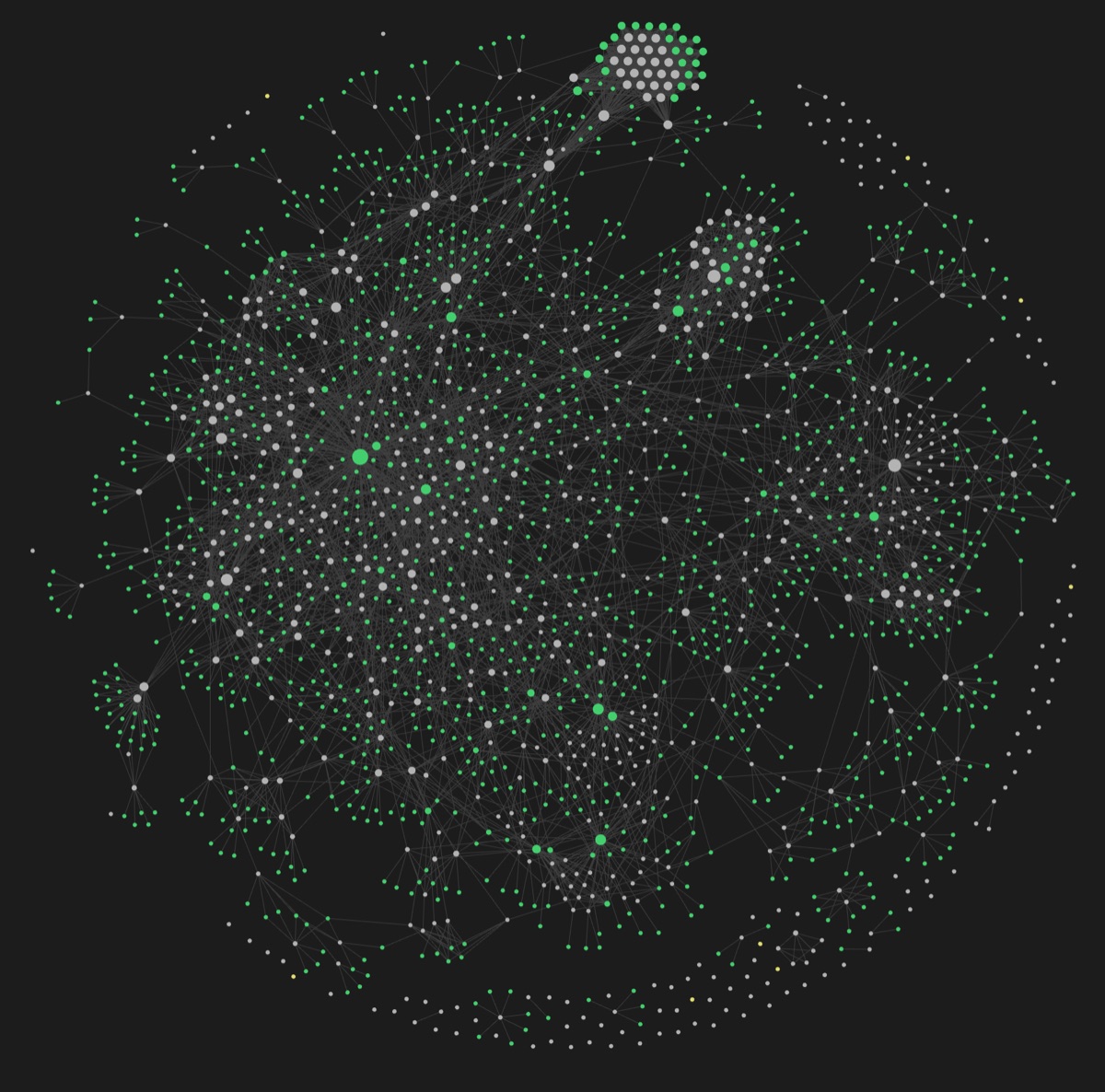
- A map of it. Obsidian draws your notes and the lines between them. Seeing your own thinking as a structure is the moment this clicks for most people.
- Claude that already knows you. Every session starts with your context loaded.
- A way to keep it true. How to update decisions and clear out what has gone stale.
About 40 minutes. Most of it is you talking about your own life.
Why we call it a fractal brain
A fractal is made by one rule: take the output, feed it back in as the input, and repeat. Structure appears that nobody drew.
That is how this grows. Everything the AI does with you becomes part of what it knows the next time. Your output is its next input. The same shape repeats at every scale: a note, a project, a life. And every part points back to the whole, so wherever you enter, you can reach everything. That is the holographic part, and it is why the map above has a centre no one placed there.
This is not a theory. The brain you are about to set up is the same one that built ANIMUS, the audio-reactive visual engine we released this year, which is itself a fractal: a seed, iterated, until a form appears. It was made by describing what it should be to an AI that already held the context, then feeding every result back in as the next instruction. Nobody sat and wrote every line. The distance from the idea to the finished thing closed the same way it will close for you. Same brain, same loop, pointed at your life instead of at sound.
What you need
- A Mac. The setup is written and tested on macOS. Windows can run the same tools, and a Windows version of the setup has not been written yet.
- The Claude desktop app, from claude.ai/download
- A Claude account. The paid plan is worth it here, but start where you are.
You do not need to know how to code and you do not need to have used Obsidian. The setup installs what is missing and explains each piece as it goes.
How to run it
- Get the folder.
Get the AI ASSISTANT folder
Not quite yet. Check back here, or drop your email and you will hear when the folder is ready.
It unzips onto your desktop as a folder called
AI ASSISTANT. Everything lives in it: your notes, your memory, and the setup itself, already inside. On your desktop on purpose, so you can see the thing you built. - Open Claude Code, pointed at that folder. Claude Code is the coding surface built into the desktop app. It has to be Code rather than a normal chat for one plain reason: a chat cannot install software or write files on your computer, and this setup does both. A chat could only tell you what to do. This does it.
- Say: "Set up my fractal brain." That is all. Nothing to install by hand and no commands to type. It finds the setup inside the folder, checks what you already have, installs what is missing, and asks before putting anything on your machine.
What happens
- It checks your computer for what is already installed, so you are not asked questions it can answer itself.
- It sets up your folder and writes the file that tells Claude how to work with you, including a short list of things it may never do without asking. That list starts restrictive on purpose.
- It installs two things, explaining each first. Obsidian, a free app that draws your notes as a map, downloaded straight from its own official site. And basic-memory, the piece that lets Claude read and write those notes, which arrives carrying everything it needs. No developer tools get added to your machine, and it never asks for your admin password.
- It interviews you. The real work, and the part only you can do. Your areas, your projects, the people who recur, and the question most people have never been asked: what do you believe about your work that others in your field would disagree with?
- It builds your vault from what you said, in your words, then reads one of your own notes back out to prove Claude can genuinely see them. A folder of files and a working memory are not the same thing, and this is the step that tells them apart.
- It opens the map. This is the moment. You see your own life as a structure.
- It teaches you the upkeep. Adding, changing your mind, and clearing out what has gone stale.
- It is not listening to you. It knows what you tell it and nothing else.
- It is not automatic. You still decide what goes in.
- It will not read your mind. A brain built from a 40 minute conversation knows 40 minutes worth. It gets better because you keep using it.
- It will not send anything, post anything, or message anyone. Ever.
The install has been run start to finish on a factory fresh Mac, so that part is tested rather than hoped for. The conversation is the newer half, and you may be among the first through it.
If anything needs a permission on your machine, it tells you what and why, and asks. If you say no, it gives you the steps to do that part yourself. Saying no is never a dead end.
After, and where this leads

Most people use it for a week before it properly lands. That is the point where you ask Claude something and it answers from your own context without you setting anything up.
This brain is step one of a larger system. The Ancient Future Collective has built what we call the Seed Germinator: a fully agentic system with one surface that holds your day, your tasks, your calendar, your projects and everything Claude has produced for you, with Claude working from the brain you just built and handing you decisions instead of chores. It runs Savej's life today, and we iterate on it constantly. What you inherit is not his brain. It is the seed of it: the same structure, planted in your own ground, growing into a mirror of your mind rather than his.
The Seed Germinator will be offered inside the AFC Circle, the collective's new home. This page stays free. If you want to hear when the Circle opens, leave your name and email and you will get the first invitation.
So the folder is not a tutorial. It is the foundation. Everything that follows plugs into it.
Questions people ask
Do I need to know how to code?
No. Claude Code is the surface that can install and write files, which is why it is used. You will not write any code.
Is my data going anywhere?
The folder is on your computer, and nothing in this setup uploads it anywhere. When Claude reads one of your notes during a session, that text goes to Anthropic the same way anything you paste into a chat does, and it is covered by your Claude account's privacy settings. Two things are worth doing before you start. In the Claude app, open Settings, then Privacy, and decide whether your chats may be used to improve Anthropic's models; that setting can be turned off, and it applies to Claude Code sessions on the same account. Second, keep anything you would not paste into a chat out of the vault: passwords, keys, other people's private details. The brain is for your thinking, not your secrets.
What does Claude keep after a session?
Anthropic keeps conversation data according to its retention policy, which depends on that same privacy setting. The current terms are at anthropic.com/privacy and they are worth a read. We keep this page honest rather than summarising a policy that can change.
Can I delete it?
Yes. Delete the folder and it is gone from your machine. What Anthropic holds from past sessions is governed by their policy and your account controls.
What if I already use Obsidian?
It will use your existing vault, or make a new one if you would rather keep them separate. It asks.
What if I do not want to install anything?
Say so. There is a smaller version using Claude's built in memory. You lose the map and the files you own, and it will tell you that plainly rather than pretending the two are equivalent.
Can I take it with me?
Yes. It is a folder of text files. That is deliberate.